
Sunburn is a common health issue travellers experience while on holiday. Yet sunburn is either regarded by travellers as an unavoidable consequence of warmer weather or is seen as something that only occurs in extreme heat. The reality is that the risk of sunburn is shaped by wider environmental factors, rather than temperature alone.
Across the globe’s most popular holiday destinations, environmental conditions such as ultraviolet (UV) intensity, daylight hours, cloud coverage, rainfall patterns, and air quality all play a significant role in determining how much harmful UV radiation will reach the skin. In some of these popular locations, the above factors combine in ways that increase exposure, even when temperatures feel manageable or cloud cover is light.
This raises an important question for travellers: are some holiday destinations making it easier to get sunburnt than others, without people realising it?
In order to delve into this, Ibiza Summer Villas has conducted a data-led study that analyses popular global travel destinations in order to identify where travellers may be most at risk of sunburn. Rather than simply focusing on a single metric, the data examines how a variety of environmental conditions work together to create sustained sun exposure.
By combining these data points, the Ibiza Summer Villas study highlights both where the sun is strongest and where environmental conditions consistently enable UV exposure.
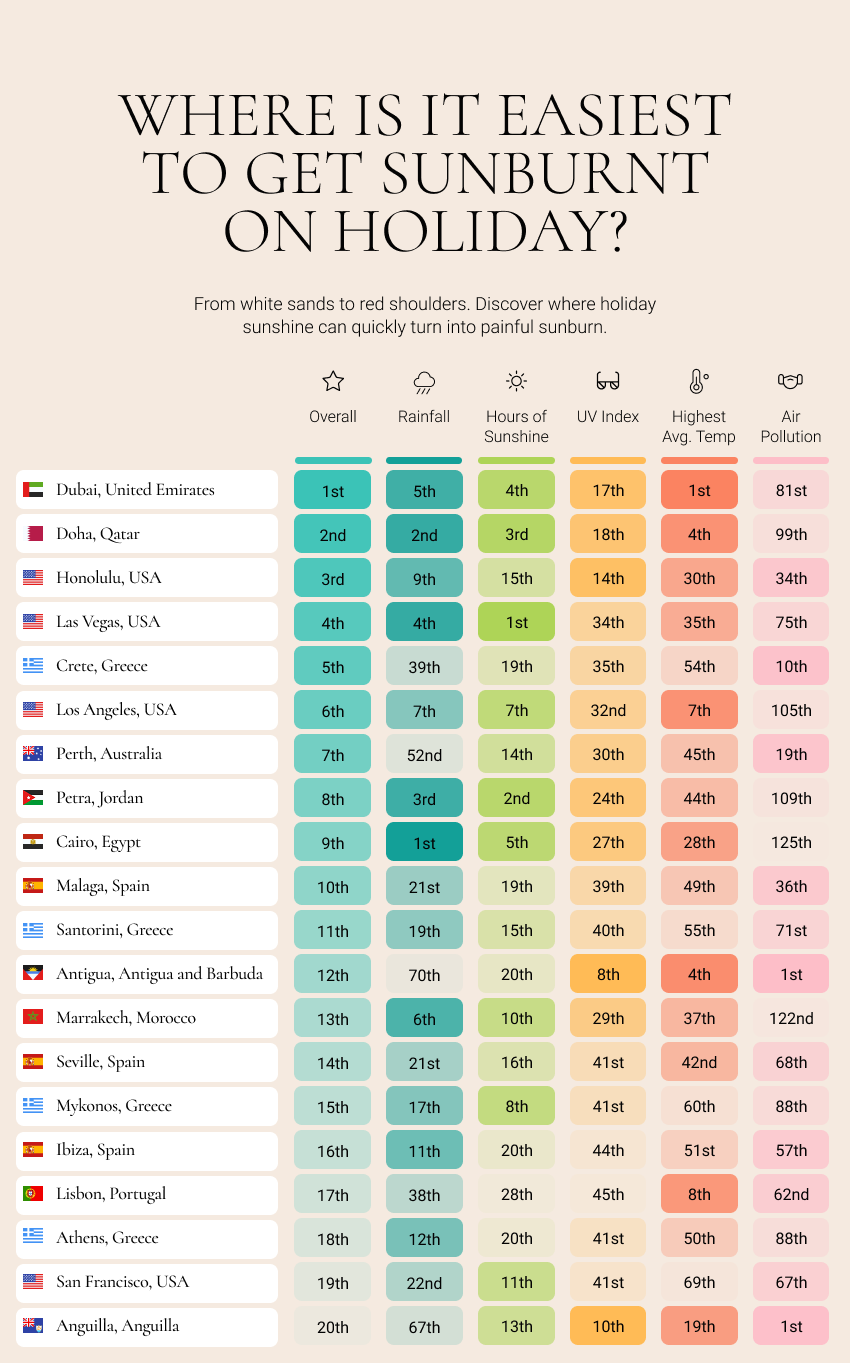
An interactive map and full destination rankings allow readers to explore the results in detail. However, several locations stand out immediately, with destinations in desert, tropical, subtropical, and Mediterranean regions dominating the highest-risk for sunburn.
How the study was conducted
In order to pinpoint the holiday destinations where it is easiest to get sunburnt, the study assessed a combination of climate, environmental, and atmospheric factors across popular global travel locations. It is important to note that each destination was ranked across eight key indicators that influence both the intensity and consistency of sun exposure.
These factors include:
- Average highest temperature: Higher maximum temperatures can encourage longer periods spent outdoors and reduce the body’s ability to cool, increasing the likelihood of sunburn.
- Average daily hours of sunshine: This measures how many hours of direct sunlight a destination typically receives each day, highlighting locations where exposure windows are longest.
- Average daily hours of daylight: Longer daylight hours increase the total amount of time skin can be exposed to UV radiation, even outside peak midday periods.
- Average UV index: A direct indicator of sunburn risk. Higher UV levels mean skin can burn more quickly, even with relatively short exposure.
- Average number of days with some rain: Fewer rainy days usually indicate more consistent exposure to direct sunlight throughout the month.
- Average monthly rainfall: This provides context on whether rainfall is light and short-lived or heavy enough to meaningfully reduce sun exposure.
- Air pollution score: Cleaner air allows stronger UV radiation to reach the ground, increasing sunburn risk.
- Average percentage of clearer skies: This measures how often skies are clear, mostly clear, or partly cloudy. Higher percentages indicate fewer natural barriers to UV exposure.
Each destination was ranked across all eight metrics, and these rankings were then combined to produce an overall sunburn risk score. This approach reflects real-world exposure conditions rather than relying on any single factor in isolation.
The holiday destinations where it is easiest to get sunburnt
.png)
The risk of sunburn exists all over the world but the data collected shows that certain holiday destinations create conditions where UV exposure is harder to avoid. The study also found that these locations tend to combine long daylight hours, clearer skies, minimal rainfall and high UV levels, all of which combined, allows harmful radiation to reach the skin for long periods of time.
Based on the combined rankings across all eight factors in the study, the below destinations emerge as the easiest for travellers to get significantly sunburnt.
1. Dubai, United Arab Emirates
Dubai ranks number one for sunburn risk due to extreme UV exposure, long daylight hours, and consistently clear skies. While high temperatures are often seen as the main risk, the data shows that minimal cloud cover and limited rainfall allow sun exposure to remain high throughout the day.
The city records the highest average maximum temperature in the study at 33.33°C, alongside long average daylight hours of 12.25 hours. UV levels remain consistently high throughout much of the year, with an average UV index of 9.08, and clear skies present around 76.25% of the year.
Rainfall in Dubai is rare, averaging just 1.17 days per month and 7.75 mm of monthly rainfall, meaning there are few natural breaks in sun exposure once travellers are outdoors. Low air pollution levels (score: 50.64) further allow UV radiation to reach the ground with little interference.
When all these factors come together, the conditions make sunburn a real risk even during short periods outside. This is particularly important for travellers unaccustomed to such intense and consistent sun exposure.
2. Doha, Qatar
Doha comes in second and shares many of the same exposure characteristics as Dubai. High UV intensity, clear skies, and long sunshine hours merge to create sustained exposure throughout the day.
The data shows Doha has a high average maximum temperature of 32.33°C, average daylight of 12.25 hours, and consistently elevated UV levels averaging 9.00 across the year. Clear skies occur approximately 74.25% of the time, further increasing exposure.
Although temperatures in Doha often encourage people to seek shade, UV levels remain high even outside peak midday hours. Rainfall is extremely limited, with just 1.25 rainy days per month on average and 6.17 mm of monthly rainfall, meaning there are few environmental barriers to reduce exposure. This increases the likelihood of sunburn for visitors who may underestimate the strength of the sun.
3. Honolulu, USA
Honolulu takes third place in the study and highlights that sunburn risk is not limited to desert climates. Located close to the equator, the city experiences consistently high UV levels year-round.
Honolulu records an average UV index of 9.58, paired with long daylight hours averaging 12.08 hours and clear skies around 71.17% of the year. While temperatures are more moderate compared to desert destinations, with an average maximum of 27.83°C, the steady intensity of UV radiation means skin can burn quickly during outdoor activities.
Rainfall in the area tends to be short-lived, averaging 9 days per month, and does not significantly reduce overall exposure. This profile highlights how destinations with comfortable temperatures can still present a high sunburn risk when UV intensity remains elevated throughout the year.
4. Las Vegas, USA
Las Vegas ranks fourth, driven by a combination of clear skies, high sunshine hours, and low rainfall. The city’s desert climate means cloud cover is minimal, allowing direct sunlight to reach the ground consistently.
Las Vegas records the highest average daily sunshine hours in the study at 10.58 hours per day, alongside long daylight hours averaging 12.08 hours. Rainfall is limited, averaging just 2.33 days per month and 7.67 mm of monthly rainfall, while clear skies are present around 74.33% of the year.
Although UV levels fluctuate seasonally, with an average UV index of 6.58, the dry climate can make the sun feel less intense than it actually is. This can lead travellers to underestimate the risk and spend extended periods outdoors without adequate sun protection.
5. Crete, Greece
Crete completes the top five and is the highest-ranking Mediterranean destination in the study. The island has long sunshine hours, high UV levels during much of the year, and relatively low cloud coverage.
Crete averages 7.75 hours of sunshine per day, with average daylight of 12.08 hours and clear skies present around 77.42% of the year. UV levels remain elevated during peak travel months, with an average UV index of 6.42, while rainfall is relatively limited, averaging 5.5 days per month.
While temperatures are often perceived as more comfortable than in desert destinations, with an average maximum of 20.75°C, the data shows that sustained UV exposure can still significantly increase the risk of sunburn. Crete’s ranking demonstrates that high sunburn risk is not limited to extreme heat, with popular European destinations facing comparable exposure during peak season.
The holiday destinations where sunburn risk is lowest
Not every holiday hotspot creates the same conditions for sustained UV exposure. At the opposite end of the rankings are destinations where lower UV intensity, cooler temperatures, and less consistent sunshine reduce the likelihood of burning. This is even during popular travel periods.
The study revealed the following destinations to have the lowest risk of sunburn for travellers:
Chamonix, France
Chamonix ranks 140 in the study, the lowest overall. The destination has one of the coldest average highest temperatures in the dataset, at just 2.08°C, alongside relatively low UV levels across the year, averaging 4.67. While clearer skies are present around 50.58% of the time, the combination of low temperatures and limited UV intensity absolutely reduces overall sunburn risk.
Krakow and Warsaw, Poland
Polish cities Krakow and Warsaw rank 139th and 138th respectively. Both cities combine modest average highest temperatures with low UV exposure. Krakow records an average highest temperature of 12.67°C and an average UV level of 3.58, while Warsaw averages 12.08°C with a UV level of 3.42. Both cities also experience lower proportions of clear skies, at 46.08% in Krakow and 43.50% in Warsaw. The greater cloud coverage plays a role in limiting prolonged and uninterrupted sun exposure for travellers.
Tromso, Norway
Tromso takes 137th place and stands out for recording the lowest average UV level in the entire study, at a startling 1.25. Although the city experiences the longest average daylight hours, at 12.58 hours per day, UV intensity remains consistently low. This demonstrates that long daylight alone does not automatically mean increased sunburn risk when UV levels are minimal.
It is important to note that lower risk does not mean there is no risk. Even in these destinations, sunburn can still happen during clear spells or after long days outdoors. With this in mind, sun protection remains relevant wherever you travel.
How Sunburn Risk Changes by Month
The risk of sunburn is not fixed throughout the year. While many travellers associate the highest risk with summer holidays, the data shows that exposure can rise at very different times depending on the location.
In some destinations, sunburn risk reaches its highest levels during spring or autumn, when UV intensity remains high but temperatures feel more manageable. In others, long daylight hours or clear skies extend exposure well beyond traditional summer months.
With this in mind, desert destinations typically maintain higher sunburn risk throughout the year due to minimal cloud cover and low rainfall, while Mediterranean locations appear to peak during peak summer travel when daylight hours and UV levels align.
Sun Safety Advice for Travellers
The Ibiza Summer Villas study showcases that sunburn risk is influenced by a variety of environmental factors. High UV levels, long daylight hours, clear skies, and low rainfall can all increase exposure, often without being noticeable.
Understanding how environmental conditions affect sun exposure can help travellers make informed decisions and reduce the likelihood of sunburn while on holiday.
We talked to Elizabeth Japal, Co-Founder & Aesthetic Practitioner Director at The Derma Lab, for her top tips on how to protect yourself from the sun whilst on holiday
When travelling to high-risk destinations with strong UV levels, the most important thing is to understand that sunburn risk isn’t driven by temperature alone. Clear skies, long daylight hours and high UV index levels mean skin can burn quickly, even when it doesn’t feel excessively hot. Travellers should think in terms of layered protection: sunscreen, clothing, shade, and timing of outdoor activities.
Sun cream should be broad-spectrum with a minimum SPF 30, though SPF 50 is preferable in destinations with high UV. SPF should be applied 20 to 30 minutes before sun exposure and reapplied every two hours, or more frequently if swimming, sweating, or towel-drying.
A common mistake is underapplying sunscreen or relying on high SPF products to last all day.
In destinations with long daylight hours, it’s sensible to avoid peak UV exposure where possible, typically between 11am and 3pm. This doesn’t mean staying indoors all day, but planning activities for early morning or late afternoon, seeking shade during midday hours, and wearing protective clothing such as hats, sunglasses, and lightweight long sleeves can significantly reduce risk. It’s also important to remember that UV exposure remains high even on cloudy days.
Common mistakes travellers make include assuming a breeze or cooler temperatures reduce burn risk, forgetting high-exposure areas like the scalp, ears, lips and tops of feet, and believing a tan offers protection. Sunburn is a sign of skin damage, not skin adapting, and repeated exposure can have lasting effects on skin health.


